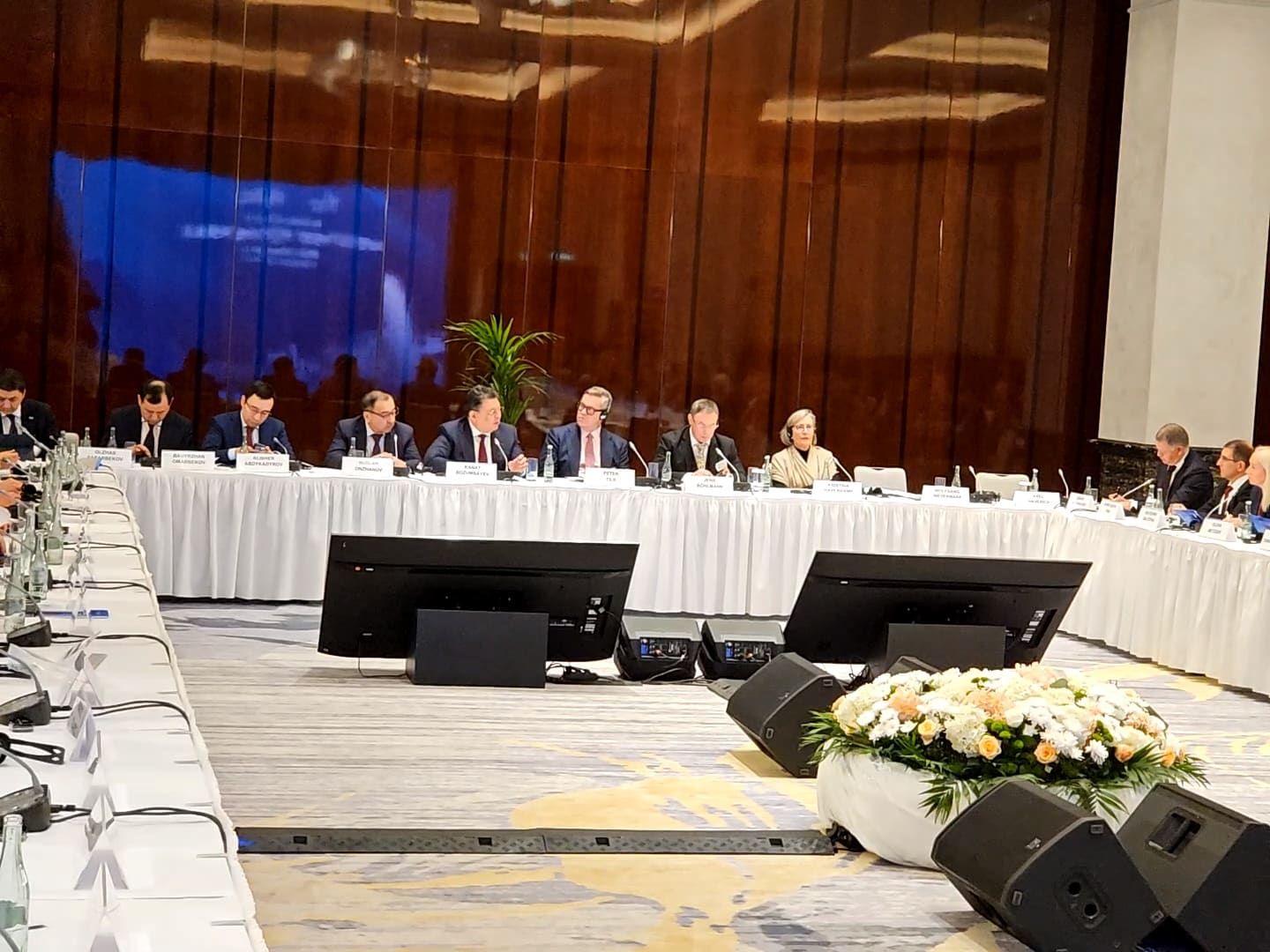
Full-fledged land acquisition via Bitcoin, an autonomous English common-law court and driverless air taxis: in the global competition among special economic zones, Alatau City is betting on radical technological innovation and exclusive special laws. At an exclusive business roadshow in Berlin, the leading figures of Kazakhstan's state leadership and Baiterek Holding set out how the 88,000-hectare infrastructure project offers investors a turnkey, bureaucracy-free platform. NewsMark attended the exclusive presentation in the conference hall on site.
Exclusive report (Part 2) by our NewsMark Central Asia expert Christian Grosse
A constitutional novelty with absolute precedence
Behind Alatau City stands not an ordinary municipal project, but a dual governance model combining direct state steering at the highest level with international expertise. In his extensive remarks, Kazakhstan's Deputy Prime Minister Kanat Bozumbayev underlined the unprecedented legal dimension: by virtue of a constitutional law, the megacity's specifically anchored system of special laws takes explicit precedence over national legislation. This special constitutional status creates an autonomous ecosystem that guarantees global investors absolute and lasting legal certainty – completely detached from conventional administrative bodies.
That this is a historic prestige project of continental rank is underscored by the clear dictum of President Kassym-Jomart Tokayev: Alatau City will go down in history as Central Asia's first true, fully automated smart city. Just how global the interest in this pilot project is can be seen from the international success of the Kazakh delegation. Before its stop in the German capital, the master plan had already met with an enormous response from institutional investors at high-profile roadshows in the global tech and financial hubs of Seoul, Shenzhen and London.
Fully digital property acquisition for foreigners and the “few clicks” process
A groundbreaking detail of this special status concerns the direct acquisition of land, which represents a major novelty for the entire region. To guarantee global investors maximum flexibility, a radically simplified ownership model has been created. Unlike in the rest of Kazakhstan's territory, foreign nationals and legal entities in Alatau City are permitted, under certain conditions, to acquire land physically and in full.
Through the special economic zone's fully digitalised interface, and in cooperation with licensed Web3 trading platforms, the acquisition of property and land rights is reduced to a minimum of bureaucratic effort. Transactions can be completed with legal certainty in just a few clicks. The technological and monetary flexibility goes so far that plots of land and commercial space can be purchased and settled directly using established digital assets such as Bitcoin, as well as US dollar-pegged stablecoins (USDT/USDC). Contracts and land-register entries are recorded simultaneously via a state-supervised blockchain architecture, revolutionising transaction speed compared with conventional notary and banking processes.
Driverless air taxis and urban air mobility
A forward-looking aspect of the urban planning concept is the full integration of urban air mobility. Alatau City is being designed from the ground up as an autonomous, drone-friendly smart city. To avoid delays, Kazakhstan has already implemented experimental aviation legislation. It enables the certification and smooth deployment of unmanned and autonomous aircraft systems far faster than under Western regulatory regimes.
In close cooperation with Alatau Advance Air Group and international partners such as AutoFlight and Joby Aviation, a $300 million ecosystem has been launched. Following the first successful eVTOL demonstration flight in May 2026, construction of the first specialised vertiport is already under way on site. By the commercial launch in 2028, an autonomous air taxi network is to connect Alatau City, Almaty Airport and the Medeu valley with a flight time of just 10 to 12 minutes. On top of this come fully automated cargo drone systems for Eurasian e-commerce logistics.
The “Tokenization by Default” financial principle
Alongside the physical infrastructure, the project is also revolutionising the financial architecture with state-of-the-art blockchain technologies. Alatau City is establishing the first “Web3-native economy”, in which the digital and real economies merge seamlessly. Under the guiding principle of “Tokenization by Default”, the entire life cycle of assets is being digitalised. “Tokenization” here means the digital securitisation of real-world tangible assets: ownership rights to real estate, infrastructure projects or operating assets with verified cash flows are cryptographically converted into digital shares, known as tokens, and registered tamper-proof on a blockchain. To this end, the Alatau Token Exchange is being built in cooperation with platforms such as Solana, Binance and Bybit, flanked by advanced feasibility studies with Tether on the introduction of a stablecoin pegged to the Kazakh tenge.
Just how radically this architecture is being put into practice is shown superbly by the megacity's undisputed flagship project: the Iconic complex. For this first vertical city district, the ceremonial groundbreaking took place only a few days ago, on 26 October 2026, with the personal participation of Deputy Prime Minister Kanat Bozumbayev; the symbolic commemorative stone was unveiled and the official start of construction of the first skyscraper was sealed. The architectural masterpiece has a purely private investment volume of more than $800 million and is being built on an extensive yet swift timeline. With geological surveys and excavation work completed in the spring, detailed design is now under way until April 2027, to be followed by official commissioning at the end of 2029.
Global architectural icons and earthquake-proof engineering
The 276,000-square-metre complex was designed by the world-famous architecture firms Skidmore, Owings & Merrill (SOM) and Zaha Hadid Architects. The asymmetrical, wedge-shaped building form is directly inspired by the silhouette of the Trans-Ili Alatau mountains. As the region is seismically active, the monument is being designed to be earthquake-proof to the strictest international standards and will be protected either by a highly advanced Japanese damping system (as in Tokyo) or by a high-strength American steel frame (as in San Francisco's Salesforce Tower).
The developer is Alatau City Development Group, while the renowned China State Construction Engineering Corporation (CSCEC) has been engaged as general contractor – a strategic partnership agreed directly during a state visit by the Kazakh President to China. CSCEC, which builds around 90 per cent of all skyscrapers in China and has delivered global landmarks such as the UN headquarters in New York, guarantees an unprecedented pace of delivery. Through the security tokens issued, both institutional funds and private investors worldwide can participate directly in the square metres and future rental income of this flagship building, without having to clear the conventional hurdles of international property transfers.
Tech & governance check: the regulatory foundation
The special economic zone's core technological and regulatory innovations were summed up for investors at the Berlin roadshow as follows:
- Legal priority: Special constitutional status – Alatau City's special laws take strict precedence over national law
- Digital land acquisition: Foreign ownership via Web3 – Full purchase of land by foreigners possible via crypto (BTC/USDT)
- Asset financing: “Tokenization by Default” – Fractional division of large-scale global projects via regulated security tokens
- Air mobility: Autonomous eVTOL network – Commercial launch from 2028; connection to the Almaty hub in 10–12 minutes
- Legal system: Autonomous common-law court – Independent jurisdiction on the British model, separate from the national judiciary
- Bureaucracy lever: “One-window” principle – All permits, licences and visa matters handled turnkey from a single source
Global corporations as economic pioneers
The Deputy Prime Minister backed up the point that these radical facilitations are no mere theory with hard facts from the practice of global industry. Major corporations have long since recognised the location's potential and are creating facts on the ground.
- PepsiCo has already built the group's second-largest production plant worldwide in Alatau City – a logistical milestone for supplying the Eurasian market.
- US food giant Mars is following suit with massive follow-on investments in order to strategically scale its market presence from the new megacity.
- German building materials group Knauf has been producing successfully in the country for more than 20 years. In view of the emergence of Alatau City and the associated wave of construction and infrastructure, the company is now planning a far-reaching capacity expansion in order to serve the rapidly growing regional demand directly on site. This industrial settlement is flanked by booming logistics: Eurasian transit volumes across Kazakh territory recently recorded a spectacular jump of 22 per cent, underlining the hub's role as a continental chokepoint.
Resource wealth and a warm invitation to Germany
An often overlooked, yet academically and economically fundamental lever for high-tech investment is Kazakhstan's geological trump card. Bozumbayev emphatically reminded the audience in the hall that, amid the global energy transition and decarbonisation, the country has critical key resources at its disposal: Kazakhstan is home to 21 of the total of 34 rare earths classified by the European Union as strategically critical. The immediate availability of these raw materials right in Alatau City's logistical hinterland makes the location unbeatable for future-proof key industries.
Against this backdrop, Kazakhstan's state leadership extended a warm and explicit invitation to German business to take an active part in shaping this Eurasian axis of the future. The Kazakh side particularly values German know-how in, among others, the following strategic core areas: 1) mechanical engineering, 2) energy efficiency, 3) water management and 4) medicine, medical technology and the pharmaceutical industry. To secure this technology transfer over the long term, the German model of dual vocational training is in especially high demand within the Kazakh administration. The system is to be fully adapted for Alatau City in order to develop a high-tech workforce qualified to German standards directly on site.
Institutional governance at government level and the management holding
Alatau City's supreme supervisory body, the Alatau City Development Council, is under the direct personal leadership of Kazakh Prime Minister Olzhas Bektenov. Its deputy chairs are Deputy Prime Minister Kanat Bozumbayev and the internationally renowned urban development expert Wong Heang Fine. The Alatau City Authority, headed by CEO Alisher Abdykadyrov, acts as an autonomous special administrative authority with far-reaching powers. The leadership team is deliberately international: among others, Nina Yang, who previously played a leading role in major urban development projects of Singapore's state planning agencies, is responsible for urban development as Deputy CEO, in order to implement global best practices directly. A decisive operational lever for companies is the consistently applied “one-window” principle, through which all administrative processes are coordinated turnkey from a single source.
Alatau City's overall portfolio currently comprises 67 core projects. Timur Onzhanov, Deputy Chairman of the Management Board of Baiterek Holding, offered in-depth insight into the mobilisation of international capital and financial safeguards. As the central state management holding, Baiterek steers the financial backing of large-scale industrial projects. Onzhanov explained the specific financing instruments, credit facilities and hedging mechanisms available to international partners in cooperation with the holding in order to minimise investment risks and scale projects efficiently. In the course of the European roadshows, contracts and memoranda of understanding worth more than $1.3 billion have already been signed, including partnerships in the British education and healthcare sectors as well as major Asian projects.
Radical tax incentives and independent jurisdiction
To offer absolute planning certainty in the global competition for foreign direct investment, Alatau City has a far-reaching, emerging autonomous legal system. Registered companies are fully exempt from almost all key tax burdens for a contractually fixed period of up to 30 years. This covers corporate income tax, property tax, value-added tax within the zone and all employer social security contributions. In addition, a constitutionally guaranteed 10-year tax stability guarantee protects investors from regulatory tightening from the moment of licensing. On top of this comes full exemption from customs duties on imports of production machinery, raw materials and technology components.
The necessary trust is provided by the special economic zone's legal architecture. Modelled on the Astana International Financial Centre in the north of the country, a specialised, fully autonomous investment court based on English common law is being established in Alatau City. This guarantees independent, transparent and internationally recognised jurisdiction that operates separately from the national judicial system and offers international partners maximum legal certainty.
Conclusion and outlook: the Eurasian future put to the test
From an analytical perspective, Alatau City is far more than a conventional infrastructure project; it is the architectural and regulatory manifesto of a new Central Asian self-confidence. In doing so, Kazakhstan is radically breaking with its image as a mere raw-materials exporter and presenting itself as an agile, digital architect on one of the most important arteries of world trade in the coming decades. The urban and economic concept is remarkably well thought out. By deliberately tapping into the purchasing-power dynamics and talent pool of the Almaty metropolis, and combining this with rigorous 30-year generational planning for social infrastructure, the project differs fundamentally from many short-sighted free trade zones. The international benchmarking, which fuses Singapore's administrative strength, Dubai's financial openness and Luxembourg's urban density, shows that Arup and Kazakhstan's state leadership are aiming for a global showcase model.
Regulatory progressiveness and a wake-up call for Europe
The project's true explosive power, however, lies in its regulatory progressiveness. A fully autonomous common-law court, combined with a bureaucracy-free one-window principle and the possibility for foreign players to acquire land with legal certainty in a few clicks via stablecoins or Bitcoin, sets international benchmarks. The fact that major projects are being tokenised, and thus opened up to global, small-ticket capital, demonstrates the technological lead of the Eurasian corridor.
The outlook for European, and especially German, business is double-edged. On the one hand, in the areas outlined by Bozumbayev, Alatau City offers a gigantic, highly attractive field of activity on a legally stabilised silver platter. On the other hand, the megacity serves as an unmistakable wake-up call. When representatives of German business associations praise the pace of implementation there on an open stage and state that Germany can learn from this pragmatic spirit, it reveals the shift in global innovation dynamics. Whether the ambitious visions from Alatau City will become reality at the forecast speed remains to be seen. But the “can-do spirit” demonstrated in Berlin clearly shows: while Europe is still debating regulation, Kazakhstan is already creating technological facts on the ground.
(Editor's note: The first part of our exclusive report on the geopolitical logistics of the Middle Corridor and the strategic dialogue with German industry can be found in yesterday's edition.)